SGT. RAWHIDE
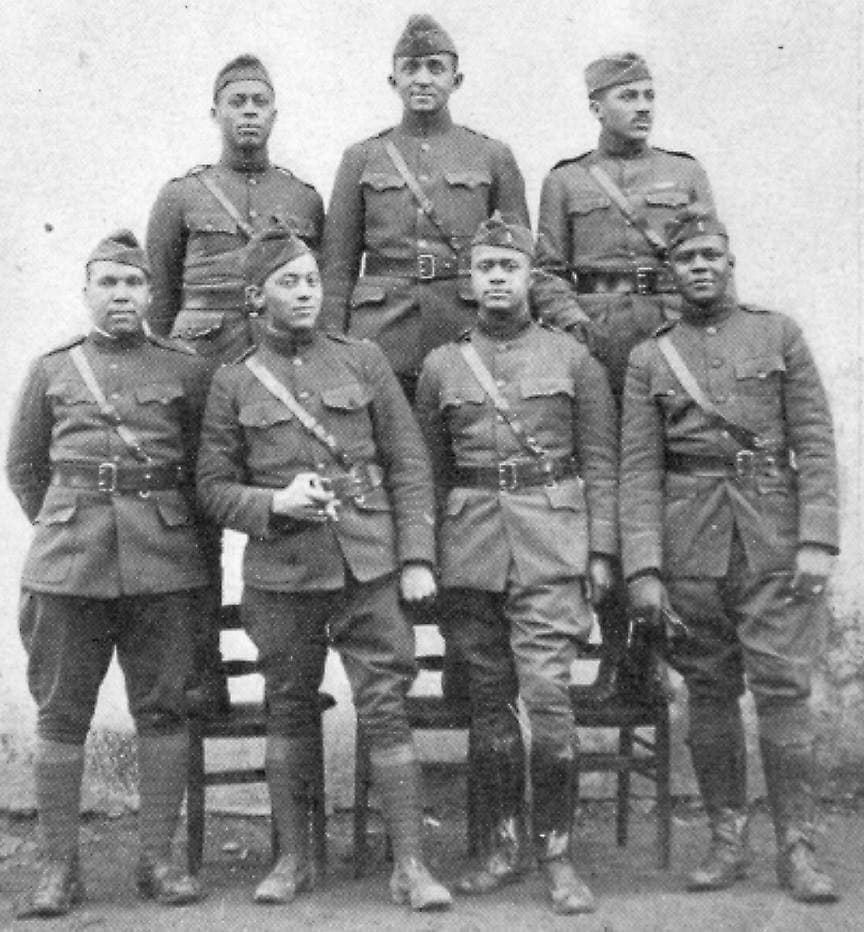
Black-and-white photograph of seven soldiers, four standing and three seated on chairs, posed against a plain wall.

93rd Division, American Expeditionary Force

The 371st Infantry Regiment

Organized at Camp Jackson, South Carolina, the 371st fought under French command in the 1918 Champagne offensive and returned home decorated with the French Croix de Guerre.

Start here

What made the 371st different

A question: Which army did the 371st fight under?

Reveal the answer

The answer

The French Army.

French rifles. French helmets. French command. The regiment was attached to the French 157th "Red Hand" Division under General Mariano Goybet, and fought there while the American Expeditionary Force declined to brigade Black regiments with white American units.

Source: Emmett J. Scott, Scott's Official History of the American Negro in the World War (1919), ch. XVI, p. 232 (opens in a new tab, leaves the Sergeant Rawhide site)

Who they were
African American draftees, predominantly South Carolinians, with smaller numbers from Florida, Georgia, North Carolina, Maryland, and Pennsylvania.
Who commanded them
White officers, mainly Southern. In France, a French division.
Whose weapons they carried
French weapons, helmets, and equipment. The 371st fought under French command. It never fought as part of the 93rd Division.

Sources: Emmett J. Scott, Scott's Official History of the American Negro in the World War (1919), ch. XVI, p. 232; 371st Infantry Regiment WWI Memorial Monument Association (371stmonument.org)

Why a French division

The 93rd Division (Provisional) that the regiment had been assigned to was never fully organized: its headquarters was demobilized in May 1918, and its regiments were loaned to the French, who needed infantry.

Source: Emmett J. Scott, Scott's Official History of the American Negro in the World War (1919), ch. XVI, p. 232

Sgt. Perry Loyd served in this regiment. Wounded in action on September 29, 1918, he survived; his Purple Heart was presented on October 13, 2018, 100 years later.

See the 100-Year Purple Heart Story

The regiment's journey

Seven stops, from Camp Jackson to France and home again. Choose a numbered stop on the map, or step through them in order.

Schematic, not to scale.

Schematic of the Atlantic crossing. The South Carolina coast is at the left with Camp Jackson inland; the coast of northwest France with Brest on the tip of Brittany is at the right. A solid curve runs from Camp Jackson to Brest and a dashed curve returns from Brest to Camp Jackson.Atlantic OceanCamp Jackson, S.C.1Brest26Home, February 19197
Across the Atlantic: Camp Jackson to Brest (1 to 2), and from Brest home to Camp Jackson (6 to 7).
Schematic outline of France with Brittany at the west, the Channel coast to the north, the Bay of Biscay to the southwest and the Mediterranean to the south. Brest is at the western tip. A solid curve runs east to Avocourt and Verrières near Verdun, then northwest to Hill 188 and Ardeuil; a dotted tick marks the regiment's monument beside Hill 188; a dashed curve returns west from Hill 188 to Brest.BrestAvocourt andVerrières3Hill 188 and Ardeuil4Monument5
In France: Brest to the line near Verdun (3), the Champagne sector (4), and back to Brest. 5 marks the regiment's monument beside Hill 188; the route does not pass through it.

Stop 1 of 7: August 31, 1917

Organized at Camp Jackson

Camp Jackson, Columbia, South Carolina

The regiment was organized on August 31, 1917, at Camp Jackson, South Carolina, initially as the 1st Provisional Infantry Regiment. On December 1, 1917, it was redesignated the 371st Infantry Regiment and assigned to the 93rd Division (Provisional).

Stop 1 of 7: Organized at Camp Jackson

Hill 188

Côte 188, known in English as Hill 188, is a German-fortified height in the commune of Ardeuil-et-Montfauxelles, in the Champagne region of France. A monument to the 371st Infantry Regiment stands there today. Cpl. Freddie Stowers' Medal of Honor citation places the action in the "Champagne Marne Sector"; this page follows that language: Hill 188, in the Champagne sector, during the Allied offensive of late September 1918.

Four errors that circulate

What gets repeated, and what the record says

Each card carries a claim you can find in print or online. Check it against the record and the source behind it.

September 28 to October 6, 1918

The scale, in Scott's own count

Each mark below is one soldier of the 371st that Emmett J. Scott counted as actually engaged in the Champagne offensive. The lighter marks are the losses he recorded.

A field of 2,384 small marks, one for each soldier of the 371st actually engaged between September 28 and October 6, 1918, as counted in Emmett J. Scott's 1919 official history. 1,065 of the marks are drawn in a lighter tone for the losses Scott recorded. He never divided that figure by kind.

  • One mark for each of the 2,384 actually engaged
  • The lighter marks are the 1,065 losses Scott recorded
2,384 actually engaged. 1,065 losses recorded by Emmett J. Scott.

One figure: Scott's word is losses.

What does losses mean?

The record

One figure. He never divided it.

Emmett J. Scott's 1919 official history records that during the fighting between September 28 and October 6, 1918, the regiment's losses, mostly sustained in the first three days, totaled 1,065 out of 2,384 actually engaged. Scott does not divide this figure into killed, wounded, missing, or captured, and this page does not either.

Source: Emmett J. Scott, Scott's Official History of the American Negro in the World War (1919), ch. XVI, p. 232 (opens in a new tab, leaves the Sergeant Rawhide site)

The record in three numbers

2,384

soldiers of the 371st actually engaged, September 28 to October 6, 1918

Source: Emmett J. Scott's official history, 1919

1,065

losses recorded by Emmett J. Scott, one figure he never broke down by kind

Source: Emmett J. Scott's official history, 1919

73years

from Cpl. Freddie Stowers' death on Hill 188 to his Medal of Honor

Source: Public Papers of the Presidents, George H. W. Bush, 1991

On the first day, September 28, Cpl. Freddie Stowers of Company C led the assault on Hill 188.

Company C, 371st Infantry

Corporal Freddie Stowers

No known photograph

No photograph of Cpl. Freddie Stowers is known to exist.

No known photograph of Cpl. Stowers exists. A portrait that circulates online and is often presented as his likeness is, per the National Park Service, "generated by Army forensics from photos of his mother and sisters," credited to the South Carolina Military Museum: a forensic reconstruction, not a photograph of him.Source: Anderson County Museum (andersoncountymuseum.sc.gov), "Corporal Freddie Stowers"

Cpl. Freddie Stowers served in Company C, 1st Battalion, 371st Infantry. He was born January 12, 1896, in Sandy Springs, Anderson County, South Carolina, worked as a farm hand, was drafted in October 1917, trained at Camp Jackson, and was promoted to corporal in May 1918.

September 28, 1918

Killed Leading the Assault on Hill 188

Cpl. Stowers was killed in action on September 28, 1918, at age 22, leading the assault on Hill 188. The Germans feigned surrender and then opened machine-gun and mortar fire, causing well over 50 percent casualties in his company. Stowers took command, destroyed a machine-gun nest, and was mortally wounded while advancing on a second trench line.

See the battle record

Buried in France

Cpl. Stowers is buried at the Meuse-Argonne American Cemetery, Romagne-sous-Montfaucon, France, Plot F, Row 36, Grave 40.

April 24, 1991

A Medal of Honor, 73 Years Later

Cpl. Stowers was posthumously presented the Medal of Honor on April 24, 1991, by President George H. W. Bush at the White House. His sisters, Georgiana Palmer and Mary Bowens, accepted it on his behalf. He was the first African American awarded the Medal of Honor for World War I service, 73 years after his death.

Why the Delay

Stowers' recommendation for the Medal of Honor was lost, or never acted on, and resurfaced during a late-1980s Army review into why no African American had received the Medal of Honor for service in either World War.

The full record

History of the Regiment, in order

Every beat above is drawn from these entries, each with its own source. Expand for the full dated record, or go straight to the sources at the end of the page.

See every entry, in order

August 31, 1917

Organized at Camp Jackson

The regiment was organized on August 31, 1917, at Camp Jackson, South Carolina, initially as the 1st Provisional Infantry Regiment. On December 1, 1917, it was redesignated the 371st Infantry Regiment and assigned to the 93rd Division (Provisional).

Composed of African American Draftees

The regiment was composed of African American draftees, predominantly South Carolinians, with smaller numbers from Florida, Georgia, North Carolina, Maryland, and Pennsylvania. It was commanded by white officers, mainly Southern.

April 1918

Attached to the French 157th Division

The regiment arrived in France in April 1918 and was attached to the French 157th Infantry Division, the "Red Hand" division, under General Mariano Goybet. The 93rd Division (Provisional) that the regiment had been assigned to was never fully organized: its headquarters was demobilized in May 1918, and its regiments were loaned to the French, who needed infantry, while the American Expeditionary Force declined to brigade Black regiments with white American units. The 371st fought under French command, using French weapons, helmets, and equipment. It never fought as part of the 93rd Division.

June 12, 1918

Into the Trenches

The 371st Infantry Regiment WWI Memorial Monument Association dates the regiment's entry into the line to June 12, 1918, holding the Avocourt and later the Verrières subsectors northwest of Verdun for more than three months.

September 28 to October 6, 1918

The Champagne Offensive

In the Champagne offensive of September 28 to October 6, 1918, the 371st captured Côte 188 (Hill 188), Bussy Ferme, Ardeuil, Montfauxelles, and Trières Ferme near Monthois. The regiment took 47 machine guns, 8 trench engines, three 77mm field pieces, a munitions depot, and railroad cars, and brought down three German aircraft by rifle and machine-gun fire.

Losses, in Scott's Own Words

Emmett J. Scott's 1919 official history records that during the fighting between September 28 and October 6, 1918, the regiment's losses, mostly sustained in the first three days, totaled 1,065 out of 2,384 actually engaged. Scott does not divide this figure into killed, wounded, missing, or captured, and this page does not either.

"The Apex of the Attacking Salient"

Scott also wrote that the 371st "was the apex of the attacking salient in this great battle," the line that gave Perry James's SGT. RAWHIDE its subtitle.

February 28, 1919

Demobilized at Camp Jackson

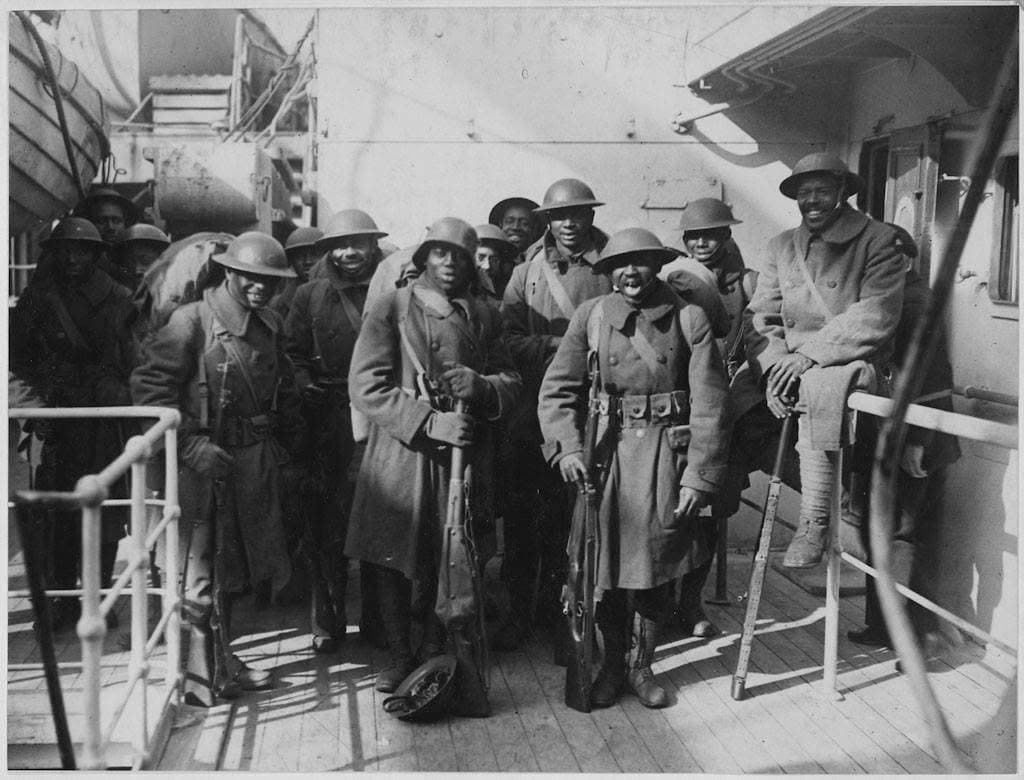
The regiment was demobilized on February 28, 1919, at Camp Jackson, Columbia, South Carolina, having returned to the United States aboard USS Leviathan. A community reception was held in the regiment's honor at Allen University in Columbia in late February 1919.

Decorations

  • Croix de Guerre awarded to members of the regiment: 41 officers and 110 enlisted men (151 in total), per the 371st Infantry Regiment WWI Memorial Monument Association.

  • Distinguished Service Cross awarded to members of the regiment: 14 officers and 12 enlisted men (26 in total), per the 371st Infantry Regiment WWI Memorial Monument Association.

See the full citation, January 27, 1919

January 27, 1919

The Regiment Decorated

The entire regiment received the French Croix de Guerre with Palm, per the 371st Infantry Regiment WWI Memorial Monument Association. Scott's own 1919 history records that the regiment "was awarded the Army citation," the French Army-level citation that carries the Croix de Guerre with Palm device, and that French Vice-Admiral Moreau decorated its colors at Brest on January 27, 1919, along with 146 individual citations. Scott's own text does not use the phrase "Croix de Guerre with Palm."

A short quiz

How Much Do You Know About the 371st?

Eight questions about a regiment whose story is still mostly untold. Every answer comes with a reveal, a plain explanation, and its source, and three of them correct errors that circulate online.

Sources

One soldier of the 371st, Sergeant Perry Loyd, has his own story told in full.

Story progress: 2 of 5, The Regiment

Continue the story

The Photographs

You have read the record. Now see the faces, the uniforms, and the memorials.

Black-and-white photograph of about fifteen soldiers in overcoats and helmets, some carrying rifles, smiling on the deck of a ship, with railings and lifeboat davits visible.